
On this page
When does a Woodstock house need 6-inch gutters?
| Situation | Why 6-inch helps |
|---|---|
| Large roof area draining to one wall | More water arrives than a 5-inch can move |
| Steep pitch, 8/12 or more | Water hits the gutter fast and can overshoot a narrow trough |
| Valley pouring into one corner | Two slopes empty into a few feet of gutter |
| Upper roof draining onto a lower roof | The lower gutter takes both roofs |
| Long runs without a second outlet | Water has further to travel |
| Pines, oaks or sweetgums overhead | More room for debris before it spills |
| Metal roofs | Faster runoff |
How does north Georgia rain affect sizing?
Gutter size is based on rainfall intensity, the most rain likely in a short burst, and on how much roof drains to each outlet. North Georgia's intensity is high. Summer thunderstorms routinely drop an inch or more in less than an hour, and tropical systems bring longer spells of heavy rain: Atlanta took 11.12 inches in 48 hours as Helene passed in September 2024. On top of that, the NOAA normal for nearby Canton is about 53 inches of precipitation a year.
Many Woodstock houses built since the 1980s are two-story subdivision homes with large, steep roof planes and several valleys. That combination, plus heavy debris from surrounding trees, is where 5-inch gutters most often fall short.
What goes with a 6-inch gutter?
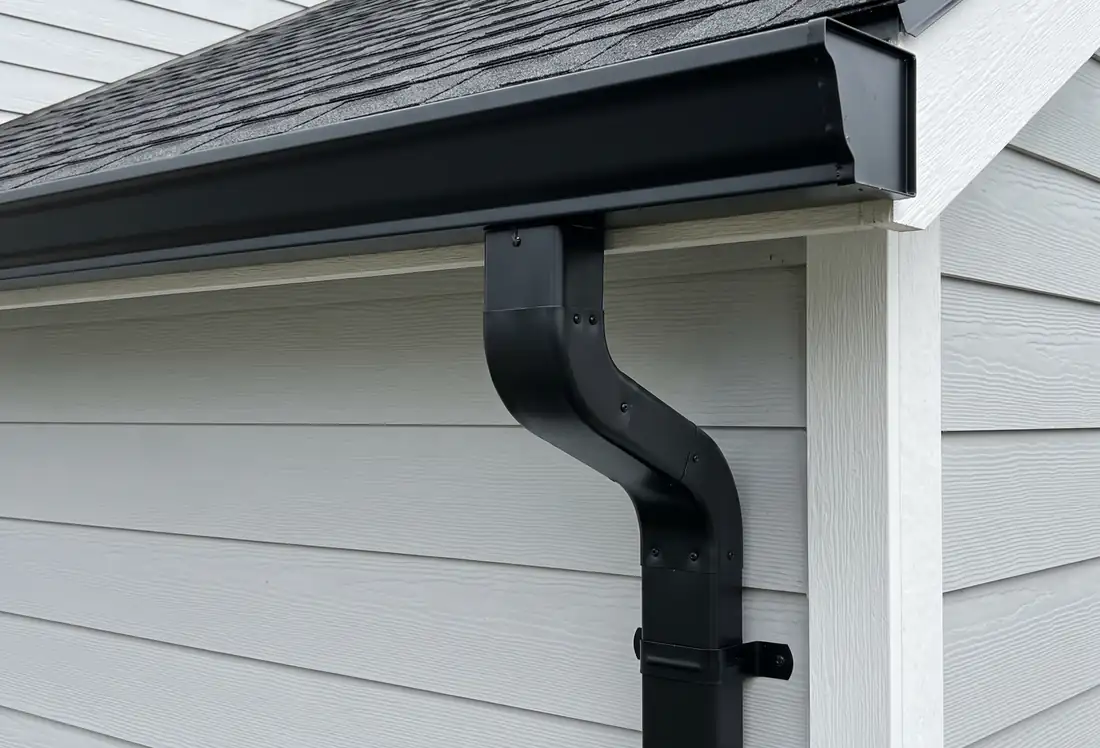
- 3x4 downspouts. A 6-inch gutter emptying into 2x3 downspouts wastes much of its capacity.
- More outlets. Enough that no outlet drains more than about 600 to 800 square feet of roof, and no stretch carries water more than about 40 feet.
- Hidden hangers about every 2 feet, closer under trees, screwed into fascia and rafter tails.
- Heavier metal. .032 aluminum or steel keeps the wider profile straight and resists hail dents.
- Discharge that can keep up. Bigger downspouts put more water at the ground, so extensions, splash blocks or buried lines matter more.
Is 6-inch always better?
No. On a simple ranch house with modest eaves and few trees, a well-maintained 5-inch system with enough outlets copes well and looks more in proportion. Some traditional houses look better with half-round. The 5-inch vs 6-inch guide goes through the decision.
How do the two sizes compare?
| 5-inch K-style | 6-inch K-style | |
|---|---|---|
| Relative capacity | Baseline | Roughly 40 percent more |
| Usual downspout | 2x3 or 3x4 | 3x4 |
| National installed price, aluminum | About $9 to $13 a foot | About $12 to $18 a foot |
| Best for | Small and simple roofs | Large, steep or tree-covered roofs |
| Debris tolerance | Spills sooner when partly clogged | More room before it spills |
Prices are national ranges from Angi and This Old House.
Can you mix sizes on one house?
Yes. Some houses get 6-inch on the large rear slope or below valleys and 5-inch on the smaller front runs. Matching the profile and color keeps it looking consistent.
Which parts come up in a 6-inch quote?
| Term | What it means on a Woodstock house |
|---|---|
| K-style gutter | The standard profile on most Cherokee County houses: flat at the back, with a decorative front edge. It holds more than a half-round of the same width. |
| Downspout | The pipe that carries water from the gutter to the ground. 2x3 and 3x4 inch are the common sizes; the larger moves about twice as much water. |
| Outlet | The opening in the gutter bottom that feeds a downspout, usually fitted with a riveted drop sleeve. |
| Roof valley | The channel where two roof slopes meet. It funnels water from both slopes into a short stretch of gutter. |
| Hidden hanger | A bracket that clips under the gutter's front lip and screws through the back into the fascia, invisible from the street. |
| Gauge | Metal thickness. Aluminum gutter usually comes in .027 or .032 inch, and the thicker coil shrugs off ladders, falling limbs and hail better. |
| Slope | How much the gutter falls toward its outlet, usually about a quarter inch per 10 feet: enough to drain without looking crooked. |
What belongs in a written gutter quote?
- The gutter size and profile: 5-inch or 6-inch K-style, or half-round.
- The metal and its thickness, such as .032 aluminum, Galvalume steel or 16-ounce copper.
- The color, and whether the downspouts match the gutter or the wall.
- The hanger type, how far apart the hangers sit and what they screw into.
- How many downspouts, what size, where they go and where each one empties.
- Fascia, soffit or drip edge repairs, priced as their own lines.
- Taking down and hauling away the old gutters.
Two quotes that both name these items can be compared line by line. A single total with none of them tells you very little.
How do you check a gutter contractor in Georgia?
Georgia's State Licensing Board for Residential and General Contractors licenses contractors for residential work valued above $2,500, and some specialty trades fall outside that rule, so ask the contractor which applies to the job in front of you. Where a license applies, confirm the number on the Secretary of State's license lookup. Ask as well for proof of liability coverage, two or three addresses of recent jobs in Cherokee or north Cobb County, and a written quote that names the gutter size, metal and thickness, color, hanger type and spacing, how many downspouts and how big, where each one drains, and who takes the old gutters away. Inside Woodstock's Downtown District, larger exterior projects go through the city's Community Development Department, so ask the contractor whether your job needs a permit.