
On this page
- How are gutters sized?
- How does north Georgia rain change the picture?
- When is 5-inch enough?
- When should you choose 6-inch?
- How do the two compare?
- Why do downspouts matter as much as gutter size?
- Is upsizing worth it on an existing house?
- How do you decide for your house?
- Do 6-inch gutters look too big?
- Can 6-inch gutters go on existing fascia?
- What should a sizing recommendation include?
How are gutters sized?
Gutter sizing balances three things:
- Roof area draining to each gutter and outlet, adjusted for pitch, since steeper roofs catch more wind-driven rain.
- Rainfall intensity, the heaviest rain likely in a short burst.
- Outlets and downspouts, which set how fast water leaves the gutter.
A gutter that is wide enough but drains through one small downspout will still overflow. A narrower gutter with plenty of large outlets can cope well.
How does north Georgia rain change the picture?
Intensity is the issue. The NOAA normal for nearby Canton is about 53 inches of precipitation a year, but what tests a gutter is how fast it falls. Summer thunderstorms here routinely drop an inch or more in under an hour, and tropical systems bring long periods of heavy rain: Atlanta took 11.12 inches in 48 hours as Helene passed in 2024. In those conditions a 5-inch gutter on a big roof plane fills faster than its outlets can drain it.
Housing matters too. Many Woodstock-area houses built since the 1980s are two-story homes with large roof planes, steep pitches and several valleys. That is the combination where 5-inch gutters most often fall short.
When is 5-inch enough?
- A one-story ranch or a simple two-story house with moderate pitch.
- No valleys pouring into short runs.
- Runs under about 40 feet, or with outlets at both ends.
- Few trees overhanging the roof.
- 3x4 downspouts, or enough 2x3 downspouts to keep up.
When should you choose 6-inch?
- Large roof planes draining to one wall.
- Steep pitches, roughly 8/12 or more.
- Valleys pouring into corners.
- Upper roofs draining onto lower roofs.
- Long runs that cannot have a second outlet.
- Pines, oaks or sweetgums overhead, so debris builds up between cleanings.
- Metal roofs, which shed water faster.
How do the two compare?
| 5-inch K-style | 6-inch K-style | |
|---|---|---|
| Relative capacity | Baseline | Roughly 40 percent more |
| Usual downspout | 2x3 or 3x4 | 3x4 |
| National installed price, aluminum | About $9 to $13 a foot | About $12 to $18 a foot |
| Look on small houses | In proportion | Can look heavy |
| Debris tolerance | Less | More |
Prices are national ranges from Angi.
Why do downspouts matter as much as gutter size?
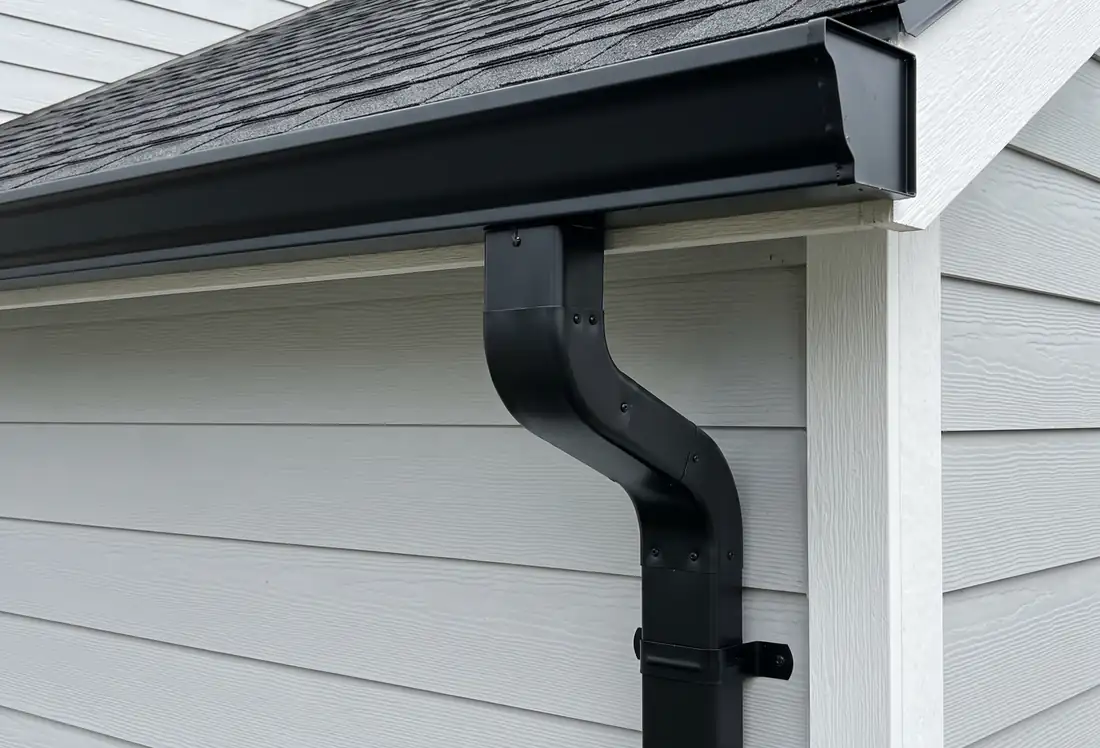
The gutter only holds water on its way to the outlet. Moving from 2x3 to 3x4 downspouts roughly doubles what each outlet can take. Adding a second outlet on a long run halves the water each one handles. On many houses, more and bigger downspouts fix overflow without changing the gutter at all. See downspouts and drainage.
Is upsizing worth it on an existing house?
If clean 5-inch gutters overflow at the same spots in every thunderstorm, and adding outlets or bigger downspouts has not fixed it, upsizing those runs is usually worth it. If overflow only happens when the gutters are full of pine straw, cleaning or guards are the cheaper fix.
How do you decide for your house?
Walk around and note which roof slopes are largest and steepest, where valleys meet the gutters, where upper roofs drain onto lower ones, which runs are longest, and what trees overhang the roof. A contractor will measure roof areas and suggest sizes. The 6-inch gutters page has more.
Do 6-inch gutters look too big?
On large two-story houses, 6-inch gutters look in proportion; most people don't notice the difference from the ground. On small one-story cottages and bungalows, they can look heavy against narrow fascia. In those cases, 5-inch gutters with extra outlets and 3x4 downspouts may give enough capacity without changing the look.
Can 6-inch gutters go on existing fascia?
Usually, if the fascia is sound and wide enough. A 6-inch gutter is heavier when full, so hanger spacing of about 2 feet into solid wood matters more.
What should a sizing recommendation include?
A contractor's recommendation should say which runs get which size, how many downspouts each run has and what size they are, and why. If a quote proposes 6-inch everywhere, ask whether some short or sheltered runs could stay 5-inch. If it proposes 5-inch on a big two-story roof with valleys, ask how it will cope with a summer cloudburst. A clear answer either way is a good sign.
How do you check a gutter contractor in Georgia?
Georgia's State Licensing Board for Residential and General Contractors licenses contractors for residential work valued above $2,500, and some specialty trades fall outside that rule, so ask the contractor which applies to the job in front of you. Where a license applies, confirm the number on the Secretary of State's license lookup. Ask as well for proof of liability coverage, two or three addresses of recent jobs in Cherokee or north Cobb County, and a written quote that names the gutter size, metal and thickness, color, hanger type and spacing, how many downspouts and how big, where each one drains, and who takes the old gutters away. Inside Woodstock's Downtown District, larger exterior projects go through the city's Community Development Department, so ask the contractor whether your job needs a permit.