
On this page
- What points toward repair?
- What points toward replacement?
- How do the costs compare?
- What role does the fascia play?
- How does storm damage change the decision?
- How does timing fit in?
- What does a contractor look at to decide?
- Can you mix repair and replacement?
- Is it worth replacing gutters before selling a house?
- What does a partial replacement look like?
What points toward repair?
- Leaks at one or two corners or end caps.
- One sagging run with sound fascia behind it.
- One crushed downspout or a jammed elbow.
- A damaged section after a limb strike or hail, on an otherwise sound system.
- Overflow fixed by cleaning, an extra outlet or a bigger downspout.
- Gutters less than about 15 years old and in good condition.
What points toward replacement?
- Leaks at most joints around the house.
- Sectional gutters with seams every 10 feet.
- Rust, pinholes or thin, heavily dented metal.
- Runs sloped wrong along their length.
- Fascia soft along much of the house.
- Gutters too small for the roof, overflowing in every thunderstorm even when clean.
- Repeated repairs every year.
How do the costs compare?
| Repair | Replacement | |
|---|---|---|
| Pricing | By the job | By the foot, plus removal and wood repair |
| Typical scope | A few joints, runs or downspouts | Whole house or whole sides |
| National reference | Varies widely by job | About $9 to $13 a foot for 5-inch aluminum, $12 to $18 for 6-inch |
| Life added | Years, if the system is otherwise sound | 20 years or more for seamless aluminum |
National replacement prices are from Angi. See the cost guide.
What role does the fascia play?
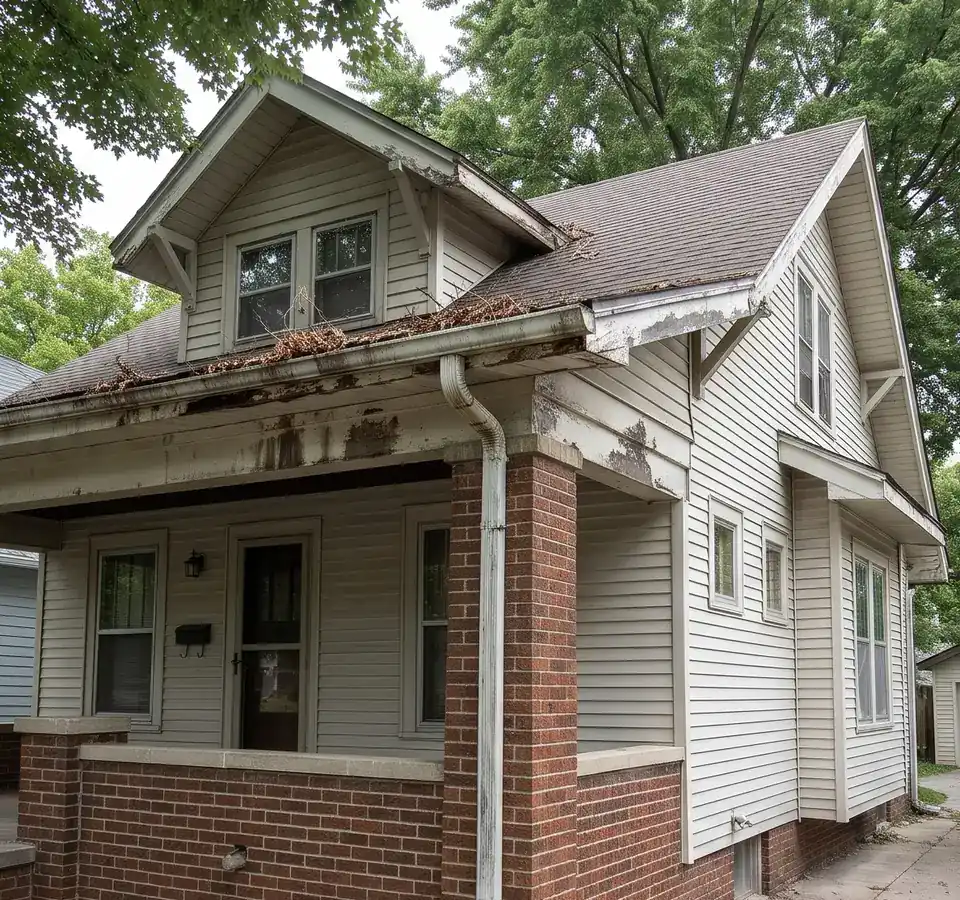
On many houses, the fascia decides it. If water has been getting behind the gutters for years, the boards may be soft along much of the house. The gutters then have to come off anyway to fix the wood, and putting old gutters back on new fascia rarely makes sense. See fascia and soffit repair.
How does storm damage change the decision?
Hail and falling limbs damage particular runs, not usually the whole system. If the rest of the gutters are sound, replacing the damaged runs is often enough. If the system was already near the end of its life, a storm can be the moment to replace it all, sometimes with insurance covering the damaged parts. See hail and storm damage.
How does timing fit in?
There is no dry season in north Georgia, but autumn is often the easiest time for replacement and fascia work, after summer storms and before the leaves fall. If the system is failing badly, a repair can hold it until replacement can be scheduled. If the roof is due within a few years, it may make sense to repair now and replace gutters with the roof.
What does a contractor look at to decide?
- The metal: thickness, corrosion, dents and how it holds its shape.
- The joints: how many leak, and whether they are seams or only corners.
- The slope: whether water drains or stands along the run.
- The fasteners: spikes, straps or hidden hangers, and how well they hold.
- The wood: fascia, rafter tails and soffit, probed for soft spots.
- The size: whether the gutters and downspouts suit the roof.
- The discharge: where each downspout puts its water.
Ask the contractor to walk you through each one. A clear explanation makes it easier to judge whether a repair or a replacement is the honest recommendation.
Can you mix repair and replacement?
Yes. Many houses get new gutters on the worst sides and repairs on the rest, or a repair now and replacement with the roof. See gutter repair and gutter replacement.
Is it worth replacing gutters before selling a house?
Leaking or sagging gutters and stained fascia are easy for buyers and inspectors to spot. Repairing obvious faults is usually worthwhile. Full replacement depends on the gutters' condition and the asking price.
What does a partial replacement look like?
A common middle path is to replace the worst sides of the house, such as a rear wall below a big roof plane or the runs damaged by a limb, and repair the rest. New runs can usually be matched in color and profile. It spreads the cost, though it means the old sections will need replacing later.
How do you check a gutter contractor in Georgia?
Georgia's State Licensing Board for Residential and General Contractors licenses contractors for residential work valued above $2,500, and some specialty trades fall outside that rule, so ask the contractor which applies to the job in front of you. Where a license applies, confirm the number on the Secretary of State's license lookup. Ask as well for proof of liability coverage, two or three addresses of recent jobs in Cherokee or north Cobb County, and a written quote that names the gutter size, metal and thickness, color, hanger type and spacing, how many downspouts and how big, where each one drains, and who takes the old gutters away. Inside Woodstock's Downtown District, larger exterior projects go through the city's Community Development Department, so ask the contractor whether your job needs a permit.